
How to Hire a Podcast Producer: What to Look For
A podcast producer runs the whole show behind the mic, not just the edit. Here is when to hire one, what to vet, and how to choose between your options.
 By Riley Shannon, Co-Founder & Managing Director at HireMango7 min read
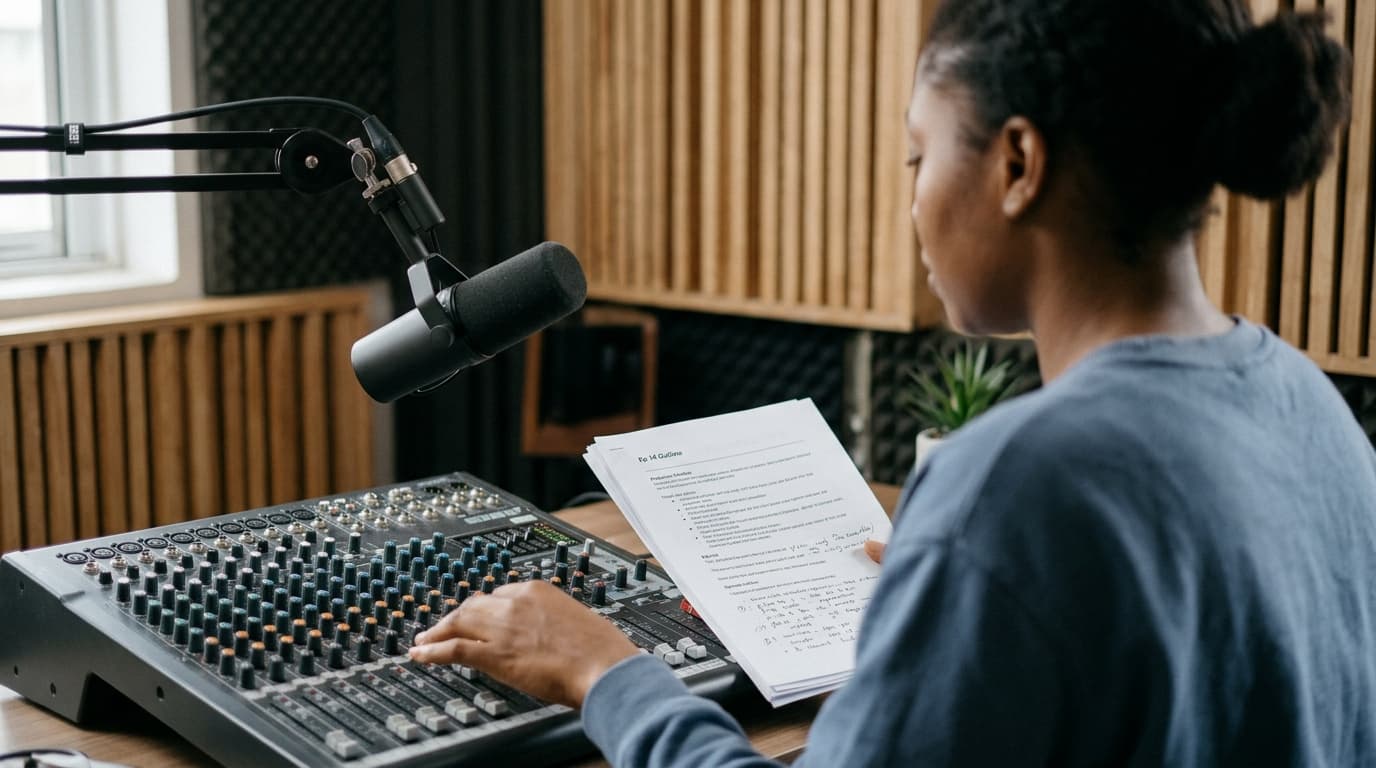
You recorded four episodes last month and published one. The guest bookings are in your inbox, the show notes are half written, and the one editor you have is waiting on a brief nobody has time to write.
That gap is the job description. To hire a podcast producer, look for someone who owns the process from guest booking to published episode, then hand them the calendar, not just the audio files. An editor cuts what you give them. A producer makes sure there is something worth cutting, on time, every week.
What does a podcast producer actually do?
A podcast producer owns the pipeline that turns an idea into a published episode, and the editing is one stage of it. The rest is planning, booking, recording, packaging and publishing.
In practice the week looks like this:
- Booking and prepping guests, including the research and the question outline.
- Running the recording session and catching audio problems while they can still be fixed.
- Managing the edit, the show notes, the clips and the artwork, and chasing each one to a deadline.
- Publishing to every platform and keeping the release calendar honest.
- Reporting on what is working so the next season gets better.
Some producers edit too. Plenty do not, and that is fine. If you are comparing prices for the edit alone, our podcast editor cost breakdown covers that role. This guide is about the person above the edit.
How is a producer different from an editor?
A producer decides what gets made and when. An editor shapes the recording they are handed. One manages the process, the other masters the craft inside it.
| Podcast producer | Podcast editor | |
|---|---|---|
| Owns | The whole episode pipeline | The audio (and video) edit |
| Starts with | The calendar and the guest list | A finished recording |
| Judged on | Episodes shipped on schedule, show quality | Clean, well-paced finished files |
| You manage them by | Setting goals and reviewing results | Giving briefs and reviewing drafts |
Many shows need both. A weekly interview show often does best with a producer running the process and an editor on the files. Both sit in our audio and video roles.
What are the signs you need to hire one?
You need a producer when the production work is costing you the show itself. You are the bottleneck: episodes wait on your reply, your approval or your calendar. Releases slip, and "weekly" has quietly become "when we can." Guests get booked late, or you scramble for one the week before. Show notes, clips and promotion happen only when someone remembers.
The clearest sign is the last one. You are growing the show into a business and the admin is eating the recording time.
Creators and agencies hit this wall at different moments. If you are a podcaster building your first team, the producer is often the second hire after an editor, because they free up the thing only you can do: show up and talk.
We tried contractors for years with constant churn and reliability issues. HireMango delivered someone full-time, highly skilled, and up to date on best practices. The onboarding was fast, the work was better, and I didn’t have to hand-hold. I’d recommend them to anyone.

What skills should a podcast producer have?
A good producer combines organization, audio judgment and people skills. Technical skill matters, but it is the easiest thing to test and the least likely to be the problem.
Look for:
- Process ownership. They can describe a repeatable weekly system and show you one they built.
- Audio literacy. They hear a bad mic, a noisy room or a clipped track and know the fix. Familiarity with a tool like Descript, Riverside or Adobe Audition is a plus.
- Editorial taste. They can tell you which 20 minutes of a 70 minute interview is the episode.
- Guest handling. Clear, warm, quick communication with people who owe you nothing.
- Written clarity. Show notes, briefs and status updates that need no follow-up.
- Reliability. They hit dates, and tell you early when they will not.
How do you vet a podcast producer?
Vet a producer with a small paid task that mirrors the job, then judge the process, not just the output. A resume tells you what they have claimed. A task shows how they work.
A checklist you can copy:
- Ask for two shows they ran end to end, with links. Ask what they personally owned versus what a team did.
- Give a 60 minute test. Send a raw recording and ask for a one-page plan: the episode angle, three clip moments, draft show notes and a release checklist.
- Ask a scenario question. "Your guest cancels the morning of a recording. Walk me through the next two hours." Good answers are calm and specific.
- Check their audio ear. Play a flawed 30 second clip and ask what is wrong with it.
- Do a 30 minute call on communication. Notice how they handle ambiguity and whether they ask good questions.
- Talk to a reference who worked with them for months, not weeks.
Red flags: vague answers about ownership, only editing samples, no view on your show, and slow replies during the process. The way they behave while you are still courting them is the best preview you will get.
Should you build, hire or use a remote specialist?
Choose based on volume and how much of the pipeline you want to hand off. If you publish occasionally, a freelancer is fine. If you ship weekly and need someone to own the process, a dedicated full-time professional beats a stack of one-off gigs.
| Option | Good for | Watch out for |
|---|---|---|
| Do it yourself | A new show, tight budget, learning the craft | You stay the bottleneck and the show stalls when you get busy |
| Freelancer per episode | Occasional or seasonal shows | Handoffs on every episode, and availability that changes |
| Local full-time hire | Teams that want someone in the room | A smaller pool to search in one city, and often a longer hiring process |
| Dedicated remote professional | Weekly shows, multiple formats, a show that is becoming a business | You still need to manage someone, and time zones need a plan |
We lean toward the dedicated remote hire for weekly shows, because the producer role rewards context. Someone who has worked on your show for six months knows your guests, your tone and your standards, and stops needing the brief.
When is this the wrong fit? A one-off season, a single launch, or a very short project is better handled by a freelancer. We also do not recommend it if you are not ready to give someone real ownership. A producer you micromanage is just an expensive assistant.
Where does HireMango fit?
HireMango helps companies and creators hire dedicated remote professionals from Latin America, Africa, Asia and the Middle East. Across 500+ professionals placed, we have learned that a role works best when one person owns it. Our team members work for one client only, so your producer is not splitting attention across other shows.
Here is how it works for you. We start with what you need the role to own, not a job title. With a 7-day time-to-match, you get your first candidates within a week (that is time to first candidates, not time to hire). You interview and choose, and pricing is from $2,500/mo, with the final quote depending on role and scope. If a placement doesn't work out, we'll find you a replacement at no extra cost, with no expiration on the guarantee.
Adam Salisbury, Owner of Superhero Training Academy, described what that kind of working relationship feels like:
"I love having someone I can lead instead of someone I have to manage."
That is the test for a producer too. You should be able to set the goal and trust the process. If you want to see the closest role we already run, start with our podcast editor page, or explore the roles we hire for. For the bigger question of how to structure the hire, our guide to hiring models walks through the trade-offs, and the fully remote team playbook covers what to do once they start.
If you want a producer in the room by next week's recording, tell us what you need at HireMango and we will send you your first candidates.
Frequently asked questions
A producer runs the whole pipeline: guest booking and prep, recording sessions, managing the edit and show notes, publishing and the release calendar. An editor focuses on the recording itself, cleaning and shaping the audio. Plenty of shows need both, with the producer directing the work and the editor delivering the files.
Give a short paid task that mirrors the real job. Send a raw recording and ask for a one-page plan with the episode angle, three clip moments, draft show notes and a release checklist. Then ask how they would handle a guest cancelling on the day. Their process tells you more than a portfolio does.
Hire when production work stops you from recording, or when releases keep slipping. If you spend more time scheduling guests, chasing files and posting than you do on the conversation, you are past the point. Many creators bring in an editor first and a producer second.
Yes. Producer work is done through shared tools, recordings and a clear calendar, so it travels well. Agree on overlap hours, a weekly check-in and where files live. A dedicated remote professional who works only for you gives the show the continuity that a rotating freelancer cannot.
Want to hire your next role without running the search?
HireMango places senior international full-time hires in seven days. Pre-vetted, dedicated to your business. Starting at $2,500/month.
Don't pay until you hire. Free replacement, anytime.
Riley Shannon
Co-Founder & Managing Director at HireMango
Riley brings over a decade of e-commerce and marketing leadership to HireMango, helping consumer brands and agencies unlock strategic growth by building full-time remote teams across CPG, eCommerce, and digital marketing.
- 10+ years in e-commerce and marketing leadership
- Focus on CPG, Consumer Brands, and eCommerce Agencies
- Co-Founder & Managing Director at HireMango
Explore roles to hire
First candidates in about a week · Don't pay until you hire
Explore more of HireMango
Browse Roles
Specialties we place, with rate ranges and what good looks like.
Offshore Hiring Guides
Evergreen guides to hiring offshore: roles, cost, vetting and management.
The HireMango Blog
Guides, data, and role deep dives for hiring remote teams.
Hiring Guides
Step-by-step playbooks for sourcing, vetting, and onboarding remote professionals.